


If you’ve ever pulled a soggy batch of fries out of your air fryer and wondered what went wrong, you’re not alone. Air fryer french fries have become one of the most searched recipes in the United States — and for good reason. They promise all the crunch of deep-fried fries with a fraction of the oil.
But here’s the hard truth: most people are making a few critical mistakes that kill the crispiness before it ever starts.
This guide fixes that. Whether you’re a beginner or a seasoned home cook, you’ll walk away with:
- A foolproof, step-by-step recipe tested in a home kitchen
- The science behind crispiness — so you understand why each step matters
- Pro-level tips that most recipes never mention
- Seasoning ideas, storage hacks, and fixes for every common mistake
Let’s get into it.
Why Air Fryer French Fries Beat Deep-Frying (Most of the Time)
Let’s be honest — a perfectly deep-fried fry from a great restaurant is hard to beat. But for everyday home cooking, the air fryer wins on almost every front.
Here’s why home cooks across the U.S. are making the switch:
- Less oil: Air fryer fries use just 1–2 teaspoons of oil versus several cups for deep frying
- Less mess: No hot oil splatter, no greasy stovetop to clean
- Faster cleanup: One basket to wash versus a heavy, oil-soaked pot
- Healthier profile: Significantly fewer calories and fat per serving
- More control: You can pause, check, shake, and season at any point
The key phrase is when done right. Air fryers work by circulating superheated air around food at high speed. That hot air draws moisture out of the potato surface and triggers the Maillard reaction — the same browning chemistry behind that golden, slightly caramelized crust you love on a great fry.
Choosing the Right Potato: This Matters More Than You Think
The single biggest variable in homemade air fryer fries is the potato you start with. Not all potatoes are created equal, and this choice alone will make or break your results.
Best Potatoes for Air Fryer Fries (Ranked)
- Russet Potatoes (Best Choice) — High starch, low moisture. Crisps up beautifully on the outside while staying fluffy inside. This is the gold standard — the same variety used by most American fast-food chains.
- Yukon Gold Potatoes (Great Runner-Up) — Slightly waxier than russets, with a naturally buttery flavor. Won’t get quite as crispy, but they’re delicious and hold seasoning well.
- Red Potatoes (Not Recommended) — Too waxy, too much moisture. They’ll cook through fine but you’ll struggle to get a truly crispy exterior.
- Fingerling Potatoes (Skip for Fries) — Fun for roasting, but their small size and waxy texture make them a poor choice for classic french fries.
Pro tip: Choose medium-to-large russets with smooth, firm skin and no green spots. Greening indicates solanine — a compound that’s mildly bitter and best avoided.
The Secret Step Most Recipes Skip: Soaking the Potatoes
Here’s where most air fryer french fry recipes go wrong — they skip the soak entirely, rush straight to seasoning, and then wonder why the fries turn out chewy.
Why soaking works: Raw potatoes are packed with surface starch. When you cook them without soaking, that starch turns gummy under heat — creating a soft, unpleasant exterior instead of a crispy one.
How to Soak Your Fries (Step by Step)
- Cut your fries into uniform sticks — aim for ¼ inch thick for classic fries or ½ inch thick for steak fries
- Place them in a large bowl of cold water, making sure all the fries are fully submerged
- Soak for 30 minutes minimum — up to 2 hours is even better for thicker cuts
- Watch the water turn cloudy — that cloudiness is excess starch releasing from the potato (exactly what you want)
- Drain completely, then spread fries on a clean kitchen towel
- Pat bone dry — press firmly to remove as much surface moisture as possible. A salad spinner works brilliantly here.
This single step transforms the texture of your fries. Do not skip it.
The Exact Recipe: Crispiest Air Fryer French Fries
Ingredients (Serves 2–3)
- 2 large russet potatoes (about 1.5 lbs), scrubbed and peeled
- 1½ teaspoons olive oil (or avocado oil for a higher smoke point)
- ½ teaspoon kosher salt (plus more for finishing)
- ¼ teaspoon garlic powder
- ¼ teaspoon smoked paprika (optional, but adds incredible depth)
- Pinch of black pepper
Step-by-Step Cooking Instructions
- Cut and soak — Slice potatoes into even ¼-inch sticks. Soak in cold water for 30–60 minutes. Drain and dry thoroughly (see soaking section above).
- Season the fries — In a large bowl, toss the dried fries with olive oil, salt, garlic powder, paprika, and pepper. Every fry should be lightly coated — not glistening or wet with oil.
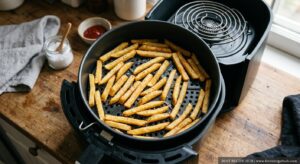
- Preheat your air fryer — Set to 380°F (193°C) and preheat for 3–5 minutes. A cold basket leads to steamed fries, not crisped ones.
- Arrange in a single layer — Place fries in the air fryer basket without overlapping. This is non-negotiable. Crowded fries trap steam and go soft.
- First cook at 380°F — Air fry for 12 minutes, shaking the basket firmly at the 6-minute mark to flip and reposition fries.
- Blast of heat at 400°F — Increase temperature to 400°F (204°C) and cook for an additional 5–8 minutes, until deeply golden and visibly crisped at the edges.
- Season and serve immediately — Transfer to a bowl, hit with a pinch of finishing salt, and serve within 5 minutes. Fries soften quickly as steam escapes.
Temperature and Timing: The Science of Crispy
Understanding the two-stage cooking method is what separates good fries from great ones.
- Stage 1 at 380°F — Cooks the potato interior through, making it fluffy and soft
- Stage 2 at 400°F — Aggressively dehydrates the exterior and drives the Maillard browning reaction
Think of it like baking bread: the inside must be done before you turn up the heat to build the crust.
Timing Guide by Cut Size
| Fry Style | Thickness | Total Cook Time | Notes |
| Shoestring | ⅛ inch | 14–16 min | Watch closely — burns fast at high heat |
| Classic Cut | ¼ inch | 17–20 min | Most forgiving; ideal for beginners |
| Steak Fries | ½ inch | 22–26 min | Soak 1–2 hours; flip manually |
| Wedges | 1 inch+ | 28–35 min | Flip with tongs, not by shaking basket |
Common Mistakes That Ruin Air Fryer Fries (And How to Fix Them)
Even experienced home cooks make these errors. Here’s exactly what goes wrong and how to correct it:
- Skipping the dry after soaking
- Problem: Wet fries create steam, not crust
- Fix: Pat with a towel, then use a salad spinner for best results
- Overcrowding the basket
- Problem: Fries on top of each other trap moisture and cook unevenly
- Fix: Cook in batches; hold finished batches in a 250°F oven on a wire rack
- Using too much oil
- Problem: Excess oil pools at the bottom and makes fries greasy
- Fix: Use no more than 1½ teaspoons for two full potatoes
- Skipping the preheat
- Problem: Cold basket delays browning and steams the exterior
- Fix: Always preheat 3–5 minutes at the target cooking temperature
- Not shaking the basket mid-cook
- Problem: One side crisps, the other steams against the basket
- Fix: Shake firmly at least once — ideally twice — during cooking
- Cutting uneven fry sizes
- Problem: Thin ones burn before thick ones finish cooking
- Fix: Use a mandoline slicer or take time to cut uniform sticks
Seasoning Variations: Beyond Basic Salt
Once you’ve nailed the base recipe, a whole world of seasoned air fryer fries opens up. Here are six crowd-pleasing combinations:
- Classic Steakhouse — Coarse sea salt + cracked black pepper + a drizzle of garlic butter post-cook
- Cajun Spice — Paprika, cayenne, onion powder, dried thyme, garlic powder. Bold and smoky.
- Parmesan Herb — Toss hot fries in finely grated Parmesan + dried rosemary immediately after cooking
- Old Bay — A Maryland classic perfect for summer cookouts and seafood pairings
- Truffle Salt — A pinch of truffle salt post-cook for restaurant-level date-night vibes
- Ranch Seasoning — Dried dill, garlic powder, onion powder. Toss fries the moment they come out.
Rule of thumb: Add dry rub seasonings before cooking. Add Parmesan, fresh herbs, and finishing salts after cooking so they don’t burn.
Frozen vs. Fresh: Which Makes Better Air Fryer Fries?
This is one of the most common questions in the air fryer french fries conversation — and it deserves a straight answer.
Fresh homemade fries pros:
- Full control over ingredients (no additives or preservatives)
- Fluffier interior when made with russets
- Customizable cut, size, and seasoning
- Better flavor depth overall
Frozen air fryer fries pros:
- Zero prep time — no peeling, cutting, or soaking
- Par-cooked and flash-frozen, so they crisp up reliably
- Consistent results every time (brands like Ore-Ida and Alexia perform well)
- Great for weeknight dinners when time is tight
How to cook frozen fries in an air fryer:
- Do not thaw — cook straight from frozen
- Set air fryer to 400°F
- Cook for 14–18 minutes, shaking every 4–5 minutes
- No oil needed — the fries have enough from processing
Verdict: Fresh wins on quality. Frozen wins on convenience. Both beat a conventional oven every single time.
Storing and Reheating Leftover Air Fryer Fries
Leftover fries are rare, but here’s exactly how to handle them when it happens:
Storing:
- Let fries cool completely before storing (never store while warm — steam destroys the texture)
- Place in an airtight container in the refrigerator
- Keeps well for up to 3 days
- Do not freeze previously cooked fries — they turn mushy on reheating
Reheating:
- Place fries in a single layer in the air fryer basket
- Set temperature to 375°F
- Heat for 3–5 minutes, shaking once at the halfway mark
- Serve immediately — they’ll be surprisingly close to fresh-cooked
What not to do: Avoid microwaving leftover fries. Microwave reheating steams them from the inside and turns them into soft, limp sticks.

Frequently Asked Question
Q1: Do I need to soak potatoes before making air fryer french fries?
Yes — soaking is essential. Submerging raw potato sticks in cold water for 30–60 minutes draws out excess surface starch, which is the primary cause of soft, chewy fries. After soaking, patting the fries completely dry is equally critical. Both steps together are the difference between average and genuinely crispy fries.
Q2: What temperature is best for air fryer french fries?
The best results use a two-stage method: cook at 380°F for the first 12 minutes to cook the potato through, then increase to 400°F for the final 5–8 minutes to crisp and brown the exterior. This approach produces fries that are fluffy inside and deeply crunchy outside — the same principle used by professional fryers.
Q3: How long do air fryer french fries take to cook?
Classic ¼-inch cut fries take approximately 17–20 minutes total. Thinner shoestring fries take 14–16 minutes. Thicker steak fries take 22–26 minutes. Always check visually — look for golden brown color and crisped, slightly curled edges as your doneness signal.
Q4: Can I make air fryer french fries without oil?
Technically yes, but results are noticeably drier and less crispy. A small amount of oil — just 1 to 1½ teaspoons — plays a critical role in heat transfer and enables the Maillard browning that creates crunch. If you’re avoiding oil for dietary reasons, a light mist of cooking spray achieves similar results without adding significant calories.
Q5: Why are my air fryer french fries soggy?
Soggy fries are almost always caused by one of three things: not drying potatoes thoroughly after soaking, overcrowding the basket (which traps steam), or using too much oil. Fix all three and the problem disappears. Also confirm your air fryer is fully preheated before adding the fries — a cold start produces steam, not crispiness.
Q6: What is the best potato for air fryer french fries?
Russet potatoes are the clear best choice. Their high starch and low moisture content produce a fluffy interior and crispy exterior — the classic french fry texture. Yukon Gold potatoes are an acceptable substitute with a slightly creamier, butterier bite. Avoid waxy varieties like red potatoes, which retain too much moisture to crisp properly.
Q7: Can I make frozen french fries in an air fryer?
Absolutely. Frozen fries cook excellently in an air fryer. Set the temperature to 400°F and cook for 14–18 minutes, shaking the basket every 4–5 minutes. No thawing or added oil is needed. The results are dramatically crispier than oven-baked frozen fries and ready in less time.
Q8: How do I keep air fryer french fries crispy after cooking?
Serve fries immediately — they begin softening within minutes as internal steam escapes. When cooking in batches, hold finished fries in a single layer on a wire rack in a 250°F oven. Never cover or stack them, as trapped steam destroys the crust. For reheating leftovers, the air fryer at 375°F for 3–5 minutes restores most of the original crispiness — far better than any other reheating method.
The crispiest air fryer french fries aren’t about expensive equipment or secret ingredients — they’re about technique. Get the potato right, soak and dry properly, respect the single layer, and use the two-stage heat method. Do those four things consistently and you’ll make fries at home that rival your favorite restaurant’s every single time.





1 Comment
[…] ordinary air fryer shrimp into something genuinely special. This formula was tested across multiple air fryer models and refined for maximum […]