
If you’ve ever pulled a piece of dry, rubbery salmon from the oven and wondered where you went wrong, this guide is for you. The air fryer is the single best tool for cooking salmon at home—it delivers a lightly crisp exterior, a moist and flaky interior, and does it all in under 12 minutes with almost no cleanup. But getting that perfect result every time isn’t about luck; it’s about understanding a few key variables: thickness, temperature, timing, and proper preparation.
Every technique here comes from repeated hands-on testing across multiple salmon cuts, thicknesses, and air fryer models. Whether you’re cooking a quick weeknight dinner or meal-prepping for the week, you’ll walk away with a bulletproof system that works consistently. You can also read our guide on baked chicken thigh recipes.
Why the Air Fryer Is the Best Way to Cook Salmon
Before diving into the method, it’s worth understanding why the air fryer outshines other cooking methods for salmon.
Head-to-Head: Air Fryer vs. Other Methods
| Method | Pros | Cons |
|---|---|---|
| Conventional oven | Even heat, batch cooking | Long preheat, often dries out exterior before center is done |
| Stovetop pan | Excellent sear, quick | Messy, requires constant attention, uneven heat |
| Grill | Smoky flavor, great char | Weather-dependent, easy to overcook |
| Air fryer | Crispy outside, moist inside, fast, hands-off, easy cleanup | Limited capacity per batch |
The air fryer circulates superheated air at high speed around the fish, creating three key advantages:
- Crispy exterior without deep frying – The rapid air movement browns the surface quickly, producing a thin, golden crust without submerging the fish in oil.
- Even, fast cooking – The consistent airflow reduces hot spots, so the center cooks at nearly the same rate as the edges.
- Minimal cleanup – No splattering oil, no soaking pans, and often just a quick wipe of the basket.
For everyday home cooks, this combination is genuinely hard to beat.
Choosing the Right Salmon for Your Air Fryer Recipe
The quality of your finished dish starts long before you turn on the appliance. Your choice of salmon variety and cut directly impacts flavor, texture, and cook time.
Salmon Varieties at a Glance
Atlantic Salmon (Farm-Raised)
- High fat content makes it naturally forgiving and difficult to dry out.
- Most widely available in grocery stores.
- Best for: Beginners and everyday weeknight cooking.
Sockeye Salmon
- Deep red color, lean, and intensely flavored.
- Dries out faster than fattier varieties—requires careful timing.
- Best for: Bold flavor seekers who will use a thermometer.
Coho Salmon
- Moderate fat, mild flavor, medium-firm texture.
- Most versatile for seasoning experimentation.
- Best for: Families or those new to cooking salmon.
King (Chinook) Salmon
- The premium option—rich, buttery, and deeply flavored.
- Most expensive but most forgiving at higher temperatures.
- Best for: Special occasions or weekend entertaining.
Fillet vs. Portion Cut: Which Should You Use?
For any air fryer salmon recipe, always use individual portion cuts (approximately 6 oz / 170 g each) rather than one large whole fillet. Here’s why:
- Better air circulation around each piece
- Consistent, predictable cook times
- Easier to season and plate individually
Pro Tip: Thickness matters more than weight. Aim for fillets 1 to 1.5 inches thick at the thickest point. Thinner portions (under 1 inch) cook in 7–8 minutes; thicker ones need 11–13 minutes.
Fresh vs. Frozen: What You Need to Know
You can absolutely cook frozen salmon in the air fryer with no thawing required. Keep these adjustments in mind:
- Add 3–4 extra minutes to your standard cook time.
- Pat off any visible ice crystals before seasoning.
- Season after the first 5 minutes, once the surface has thawed enough to hold the rub.
- Always check internal temperature rather than relying on time alone.
Essential Equipment and Setup
You don’t need a specialty appliance, but a few details will meaningfully improve your outcome.
What You’ll Need
- 5–7 Quart Basket-Style Air Fryer – Fits 2–4 salmon portions comfortably. Overcrowding is the #1 beginner mistake—it traps steam, blocks airflow, and prevents the surface from crisping. Always leave at least half an inch of space between fillets.
- Instant-Read Thermometer – Non-negotiable for consistent results. Visual cues alone are unreliable.
- Parchment Air Fryer Liners – Optional but strongly recommended. They prevent sticking without adding oil, make cleanup take under 30 seconds, and don’t interfere with airflow when properly sized.
Preheating Is Non-Negotiable
Preheat your air fryer at 400°F (200°C) for a full 3–5 minutes before adding the salmon. Skipping the preheat causes uneven cooking—hot edges with an undercooked center. This is one of the most common mistakes, and fixing it immediately improves results.
The Perfect Air Fryer Salmon Recipe (Step-by-Step)
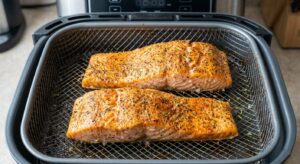 Two 6-ounce salmon fillets seasoned and placed skin-side down in the air fryer basket, ready to cook.
Ingredients – Serves 2
- 2 salmon fillets, skin-on (approx. 6 oz / 170 g each, about 1–1.25 inches thick)
- 1 tablespoon olive oil
- 1 teaspoon garlic powder
- ½ teaspoon smoked paprika
- ½ teaspoon kosher salt
- ¼ teaspoon black pepper
- 1 teaspoon brown sugar (optional – creates a light caramelized crust)
- Lemon wedges, for serving
Step-by-Step Instructions
Pat the salmon completely dry – Use paper towels to remove all surface moisture from both sides of each fillet. Moisture prevents a good crust from forming. This is the most commonly skipped step—and the most common reason for disappointing results.
Mix and apply your seasoning – Combine garlic powder, smoked paprika, salt, pepper, and brown sugar in a small bowl. Brush each fillet evenly with olive oil on all sides, then press the spice blend firmly onto the top and sides. Let it rest at room temperature for 5–10 minutes while the air fryer preheats.
Preheat your air fryer – Set to 400°F (200°C) and preheat for 3–5 minutes.
Place salmon skin-side down – Lightly spray or brush the basket with oil. Lay fillets skin-side down, spaced apart. Do not overlap or crowd the basket.
Cook for 8–11 minutes – For 1-inch fillets, start checking at 8 minutes. For 1.25–1.5-inch fillets, start checking at 10 minutes. Do not flip—the circulating air handles both sides evenly.
Check internal temperature – Insert thermometer into the thickest part of the fillet. Pull at 125°F–130°F (52°C–54°C) for moist, medium-style salmon, or at 145°F (63°C) for fully cooked through per FDA food safety guidelines. The USDA recommends cooking fish to 145°F, but many chefs prefer pulling at 125°F–130°F for a silky, restaurant-style texture.
Rest, then serve – Leave salmon in the basket for 1–2 minutes after cooking. Plate immediately with fresh lemon wedges while the exterior is still slightly crisp.
Flavor Variations Worth Trying
Once you’ve nailed the base recipe, these variations keep the dish exciting all week long. Each one uses the same method—only the seasoning changes.
- Honey Garlic – Whisk 2 tablespoons honey + 2 minced garlic cloves + 1 tablespoon soy sauce. Brush on during the last 2 minutes of cooking for a sticky, caramelized glaze.
- Teriyaki Glaze – Pre-marinate fillets for 30 minutes in a 2:1 ratio of soy sauce to mirin. Cook as directed. Finish with sesame seeds and sliced scallions.
- Lemon Herb – Skip the paprika. Season with fresh dill, lemon zest, and a pinch of crushed red pepper. Light, bright, and crowd-pleasing.
- Everything Bagel – Brush with olive oil and press Everything Bagel Seasoning generously onto the flesh side before cooking. Unexpectedly brilliant.
- Cajun-Style – Replace the smoked paprika with a full Cajun spice blend and increase quantity by 50%. Bold, spicy, and ideal for rice bowls.
Common Mistakes and How to Avoid Them
Even with a reliable recipe, small errors can derail the result. Here are the five most frequent pitfalls—and exactly how to sidestep each one:
- Not preheating the air fryer – The single biggest contributor to uneven cooking. Always preheat at full temperature for at least 3 minutes.
- Placing salmon skin-side up – The skin protects delicate flesh from the direct blast of hot air and prevents sticking. Always cook skin-side down for the full duration.
- Cooking straight from the refrigerator – Cold fish cooks unevenly—the exterior overcooks before the center finishes. Rest fillets at room temperature for 10–15 minutes before cooking.
- Skipping the oil and dry rub – Without fat on the surface, seasonings don’t adhere and the exterior stays pale and limp. A thin coat of oil is essential.
- Trusting time over temperature – Air fryer models vary significantly in actual heat output. A thermometer takes 10 seconds and eliminates every guessing game.
Storage, Meal Prep, and Reheating
Storage Rules
- Store cooked salmon in an airtight container in the refrigerator.
- Stays fresh and safe for up to 3 days.
- Do not leave cooked fish at room temperature for more than 2 hours.
Meal Prep Strategy
Season and portion raw fillets up to 24 hours in advance and store covered in the refrigerator. Salt slowly draws out surface moisture, then reabsorbs into the flesh—seasoning it more deeply from within. This is a standard restaurant prep technique that works beautifully at home.
How to Reheat Without Ruining It
- Air Fryer at 300°F (150°C) for 3–4 minutes – Best result, stays moist and lightly crisp.
- Oven at 275°F (135°C) for 10–12 minutes – Acceptable but slower.
- Microwave – Avoid entirely; it makes the texture dry and rubbery.
Reheating Tip: Spritz the surface with a little water or lay a thin lemon slice on top before reheating in the air fryer. This prevents surface drying during the warm-up cycle.
Serving Suggestions
Air fryer salmon is a genuinely versatile protein that pairs well with a wide range of sides. For a complete meal, try serving it alongside some of these accompaniments:
- Grains – Brown rice, quinoa, farro, or couscous all absorb the cooking juices beautifully.
- Vegetables – Roasted asparagus, broccolini, zucchini, or green beans. Many can be cooked in the air fryer simultaneously—just adjust timing.
- Salads – Arugula with parmesan and lemon vinaigrette, or a simple cucumber-dill salad.
- Sauces – Tzatziki, avocado crema, Dijon cream sauce, or miso butter.
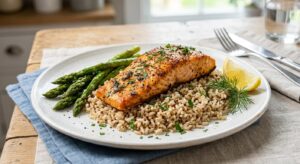 Air fryer salmon served with brown rice, roasted asparagus, and a lemon wedge—a balanced, restaurant-quality meal at home.
Frequently Asked Questions
Q1: What temperature should I cook salmon in the air fryer?
Cook at 400°F (200°C). This creates a lightly crispy exterior while keeping the interior moist. Always preheat for 3–5 minutes before adding the fish.
Q2: How long does salmon take in an air fryer?
8 to 12 minutes at 400°F depending on thickness. A 1-inch fillet takes 8–9 minutes; a 1.5-inch fillet needs 11–12 minutes. Always verify with a thermometer.
Q3: Do I need to flip salmon in the air fryer?
No. Do not flip. The circulating air cooks all sides evenly. Place skin-side down and leave it for the full cook time. Flipping risks breaking the delicate flesh.
Q4: Can I cook frozen salmon in the air fryer without thawing?
Yes. Cook at 400°F for 12–15 minutes. Pat off ice crystals, season after the first 5 minutes, and always confirm doneness by temperature—not time.
Q5: What internal temperature should salmon reach in the air fryer?
For medium restaurant-style salmon, pull at 125°F–130°F (52°C–54°C) —moist, slightly translucent at the very center. For fully cooked salmon per FDA guidelines, cook to 145°F (63°C). Use a thermometer; visual judgment is unreliable.
Q6: Why is my air fryer salmon dry?
Usually one of four reasons: cooking past 145°F, using a lean variety without adjusting time, skipping the oil coating, or cooking straight from the fridge. Fix all four and the problem disappears.
Q7: Can I cook salmon with the skin on in the air fryer?
Yes—skin-on is actually preferred. The skin protects the flesh from direct heat, holds the fillet together, and crisps up nicely. Place skin-side down; it releases cleanly when done.
Q8: How do I store and reheat leftover air fryer salmon?
Store in an airtight container in the refrigerator for up to 3 days. Reheat in the air fryer at 300°F for 3–4 minutes—never the microwave. A small spritz of water or a lemon slice on top before reheating preserves moisture.
Conclusion
Cooking perfect air fryer salmon isn’t about talent—it’s about a repeatable system. Preheat the air fryer, pat the fish dry, season with confidence, and always use a thermometer. Once you lock in the right temperature (125°F–130°F for silky, 145°F for fully cooked) and match the cook time to thickness, you’ll never suffer through dry, rubbery salmon again.
Your next step: Try this recipe tonight with one of the flavor variations, then explore other proteins you can master in the air fryer—like our guide to air-fried chicken breast or a batch of crispy air-fried vegetables as a side. For more complete meal ideas, browse our full recipe collection to build a weekly rotation that keeps dinner exciting and effortless.



4 thoughts on “How to Make Perfect Air Fryer Salmon Every Single Time”