

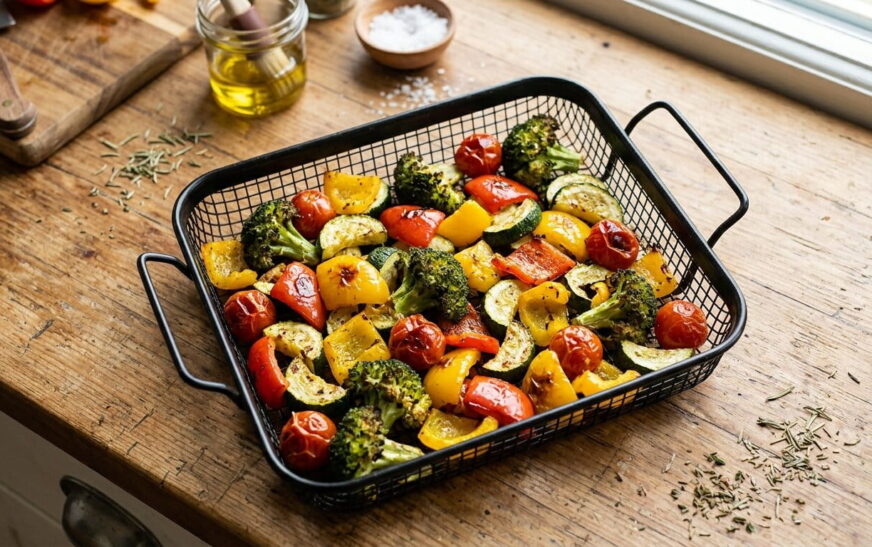
You already know you should eat more vegetables. But between soggy oven-roasted broccoli and limp steamed carrots, motivation fades fast. That’s exactly why air fryer vegetables have become one of the most searched cooking topics online – and once you understand why they work so well, you’ll never go back to the oven.
After testing dozens of vegetable combinations across multiple air fryer models, one truth is clear: the air fryer is the single best tool for cooking vegetables quickly without sacrificing texture, color, or nutrition. In 10 minutes or less, you get caramelized, crispy-edged vegetables that taste like a restaurant side dish.
Why the Air Fryer Is a Game-Changer for Vegetables
Traditional oven roasting takes 25–40 minutes and often delivers uneven results. Steaming preserves nutrients but kills flavor. Pan-frying demands too much oil. The air fryer solves all three problems at once.
Here’s exactly why it works:
- Rapid hot air circulation mimics deep frying without submerging food in oil
- High heat concentration triggers the Maillard reaction – that golden, caramelized crust
- Smaller cooking chamber means faster, more even cooking than a conventional oven
- Minimal oil requirement – usually just 1–2 teaspoons – keeps the dish genuinely light
- Less cleanup – most air fryer baskets are dishwasher-safe
A study in the Journal of Food Science confirmed that air frying retains more antioxidants in vegetables than deep frying, while significantly reducing acrylamide formation. Faster and more nutritious – that’s a rare combination.
The Best Vegetables for the Air Fryer
Not every vegetable performs equally well. Through hands-on testing, here are the ones that consistently deliver outstanding results:
High-Performers (Ready in Under 10 Minutes)
| Vegetable | Time | Temp |
| Broccoli florets | 7–8 min | 400°F (200°C) |
| Zucchini rounds | 8–10 min | 390°F (198°C) |
| Asparagus spears | 6–8 min | 400°F (200°C) |
| Bell pepper strips | 8–10 min | 380°F (193°C) |
| Cherry tomatoes | 5–7 min | 375°F (190°C) |
| Green beans | 7–9 min | 400°F (200°C) |
| Mushroom slices | 6–8 min | 380°F (193°C) |
Dense Vegetables (Need a Bit More Time)
- Brussels sprouts – 12–15 minutes at 375°F; halve them for maximum crispiness on the outer leaves
- Sweet potato cubes – 15–18 minutes at 380°F; cut into ½-inch pieces to significantly speed up cooking
- Baby carrots – 12–14 minutes at 380°F; roll them thoroughly in oil and seasoning before cooking
- Beets – 20–25 minutes at 375°F; peel and cube before cooking for the best texture
Pro Tip: Cut dense vegetables into smaller, uniform pieces to bring them into the 10-minute window. A sweet potato cut into ½-inch cubes cooks in a fraction of the time compared to thick wedges.
The Perfect Air Fryer Vegetables Formula (Step-by-Step)
This is the core method that works for virtually any vegetable combination. Follow these five steps and you will get crispy, evenly cooked results every single time.
Step 1: Prep and Thoroughly Dry Your Vegetables
Moisture is the enemy of crispiness. After washing your vegetables, follow this prep sequence:
- Pat all vegetables completely dry with a clean kitchen towel or paper towels
- Cut into uniform pieces – approximately 1 to 1.5 inches per piece
- Remove any tough stems, seeds, or inedible skins
- Let them air-dry for 2–3 extra minutes on the cutting board if you have time
Any surface water steams the vegetables instead of roasting them – resulting in soft, textureless pieces instead of crispy golden edges.
Step 2: Season Generously
This is where most home cooks undersell themselves. A drizzle of oil and a pinch of salt is a starting point, not a finish line.
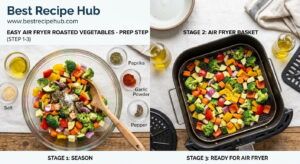
The base seasoning recipe (for 2–3 cups of vegetables):
- 1–1.5 teaspoons of olive oil or avocado oil
- ½ teaspoon kosher salt
- ¼ teaspoon freshly cracked black pepper
- ½ teaspoon garlic powder
Optional flavor boosters to add before cooking:
- Smoked paprika – adds rich, smoky depth to any vegetable
- Cumin and chili flakes – delivers a satisfying, subtle heat
- Italian seasoning – brings herbaceous, Mediterranean character
- Onion powder – a quiet but powerful background flavor
Finishing touches to add after cooking:
- Freshly grated Parmesan, lemon zest, balsamic glaze, or fresh herbs like parsley, basil, or chives
Toss everything in a large mixing bowl before adding to the basket. Every surface should be lightly and evenly coated – not dripping with oil, just glistening.
Step 3: Never Overcrowd the Basket
This is the single most common mistake people make with air fryer vegetables. Follow these rules without exception:
- Spread vegetables in a single layer with visible space between each piece
- If cooking a large batch, work in 2–3 rounds rather than stacking
- A half-full basket consistently outperforms a packed one
- Use a basket liner with holes to allow full air circulation from underneath
Step 4: Shake or Flip at the Halfway Point
- Shake the basket at the midpoint of the cook time – this is non-negotiable
- Use silicone-tipped tongs to flip individual pieces for even more precise browning
- This ensures all sides get equal exposure to the hot circulating air
- Add any cheese or delicate toppings after flipping, in the final 2 minutes
Step 5: Check Early and Adjust Accordingly
Air fryer models vary by brand and wattage. Check your vegetables 2 minutes before the suggested time. Look for:
- Lightly charred edges and a tender-but-firm interior (pierce with a fork)
- Vibrant, deep color – most vegetables hold color beautifully when air fried
- Pale and limp = needs more time or higher heat
- Overly dark or bitter = reduce temperature by 10–15°F next time
5 Best Seasoning Combinations for Air Fryer Vegetables
Here are five thoroughly tested combinations worth rotating through your weekly cooking:
- Garlic Herb (The Classic) – garlic powder, thyme, rosemary, olive oil; best with zucchini, mushrooms, and asparagus
- Spicy Cajun – Cajun blend, cayenne, smoked paprika; best with corn, okra, and bell peppers; finish with hot honey
- Asian-Inspired – sesame oil, soy sauce, ginger powder; best with broccoli, bok choy, and snap peas; finish with sesame seeds
- Lemon Parmesan – lemon zest, grated Parmesan, garlic, olive oil; best with asparagus, green beans, and cauliflower
- Balsamic Honey – balsamic reduction, raw honey, garlic; best with Brussels sprouts, carrots, and beets; finish with goat cheese
Nutritional Benefits of Air Fryer Vegetables
One of the most compelling reasons to cook air fryer vegetables regularly is the nutritional payoff:
- Uses 70–80% less oil than pan frying or deep frying
- Preserves water-soluble vitamins (B and C) better than boiling, where they leach into the water and are discarded
- Retains full fiber content regardless of cook time
- No hidden additives – you control every ingredient
- Lower calorie density – same volume of satisfying food, significantly less fat
For families reducing calories without sacrificing flavor, air frying is one of the most sustainable dietary tools available.
7 Common Mistakes to Avoid
Even experienced home cooks fall into these traps. Eliminate all seven and you will see an immediate improvement in results:
- Skipping the pat-dry step – accounts for 80% of all crispiness failures; always dry before cooking
- Using too much oil – excess oil creates greasy vegetables, not crispier ones; 1–1.5 teaspoons is the maximum
- Not preheating the air fryer – always preheat 2–3 minutes before adding food
- Mixing vegetables with mismatched cook times – stagger dense and delicate vegetables to avoid one batch overcooking
- Overpacking the basket – a single layer with space between pieces is mandatory, not optional
- Skipping the finishing touch – a pinch of flaky salt or a squeeze of lemon right before serving makes an outsized difference
- Not adjusting for your specific machine – every air fryer model runs slightly differently; dial in your sweet spot over the first few uses
Meal Prep with Air Fryer Vegetables
Air fryer vegetables are a meal-prepper’s best friend. Cook a large mixed batch on Sunday and you have a versatile, healthy base ready for the entire week. Use them in grain bowls, wraps, pasta, alongside eggs, or blended into soups.
Storage and reheating – done right:
- Cool completely before storing – never seal warm food in a container
- Store in an airtight container in the refrigerator for up to 4 days
- Keep sauces and dressings stored separately to preserve texture
- To reheat and restore crispiness: air fryer at 350°F for 3–4 minutes
- Avoid the microwave – it introduces steam and makes everything soft and rubbery
- For longer storage, freeze flat on a baking sheet first, then transfer to a freezer bag for up to 2 months
Quick Reference: Full Temperature and Time Chart
| Vegetable | Temp | Time | Key Tip |
| Broccoli | 400°F | 7–8 min | Cut small; shake at 4 min |
| Cauliflower | 400°F | 10–12 min | Florets; shake halfway |
| Zucchini | 390°F | 8–10 min | ½-inch rounds work best |
| Asparagus | 400°F | 6–8 min | Thin spears cook faster |
| Bell peppers | 380°F | 8–10 min | Strips over chunks |
| Green beans | 400°F | 7–9 min | Toss in oil very thoroughly |
| Mushrooms | 380°F | 6–8 min | Slice evenly for uniform cooking |
| Corn on cob | 400°F | 12–14 min | Brush with butter before cooking |
| Brussels sprouts | 375°F | 12–15 min | Halve for crispy outer leaves |
| Sweet potato cubes | 380°F | 15–18 min | ½-inch cubes for speed |
| Cherry tomatoes | 375°F | 5–7 min | Keep whole; check early |
| Baby carrots | 380°F | 12–14 min | Roll in oil coating very well |
Frequently Asked Questions
Q1: What temperature should I use for air fryer vegetables?
For most air fryer vegetables, 375°F to 400°F (190°C to 200°C) is the ideal range. Higher temperatures produce more caramelization and crispiness. Delicate vegetables like cherry tomatoes do better at 375°F, while hardy vegetables like broccoli and Brussels sprouts thrive at 400°F.
Q2: Do I need to preheat the air fryer before cooking vegetables?
Yes. Always preheat your air fryer for 2–3 minutes before adding vegetables. This ensures the cooking environment is immediately hot, which contributes to crispier results and more even browning from the very first minute of cooking.
Q3: Can I cook frozen vegetables in the air fryer without thawing them first?
Yes – frozen vegetables cook well in the air fryer without thawing. Add 3–5 minutes to the standard cook time at 400°F. Let them sit in the basket for 3 minutes first, then shake, add oil and seasoning, and finish cooking for the best texture.
Q4: Why are my air fryer vegetables coming out soggy instead of crispy?
Soggy results come from three causes:
- Not drying vegetables before cooking
- Overcrowding the basket so air cannot circulate
- Using too much oil, causing steaming instead of roasting
Pat dry, cook in a single layer, and use no more than 1–1.5 teaspoons of oil per 2–3 cups of vegetables.
Q5: Can I use cooking spray instead of oil in the air fryer?
Yes – avocado oil spray or olive oil spray work well. Avoid propellant-based aerosol sprays like standard PAM, as they degrade non-stick coatings over time. A refillable oil mister is the best long-term option.
Q6: What vegetables work best when cooked together in the air fryer?
Pair vegetables with similar cook times. Proven combinations:
- Broccoli and cauliflower florets
- Zucchini rounds and bell pepper strips
- Asparagus spears and sliced mushrooms
- Green beans and cherry tomatoes
Avoid mixing dense vegetables like carrots with quick-cooking ones like spinach in the same basket.
Q7: How do I store and reheat leftover air fryer vegetables?
Store leftovers in an airtight container in the refrigerator for up to 4 days. To reheat and restore crispiness, return them to the air fryer at 350°F for 3–4 minutes. Always avoid the microwave – it introduces steam and makes previously crispy vegetables soft and rubbery very quickly.
Q8: Are air fryer vegetables healthier than oven-roasted vegetables?
Both are healthy choices, but air fryer vegetables typically require significantly less oil, making them lower in calories and fat. The faster cook time also preserves more heat-sensitive vitamins like vitamin C. Most importantly, air frying makes vegetables so quick and delicious that people eat more of them – and that habit is the greatest nutritional benefit of all.
The bottom line: Air fryer vegetables are one of the quickest, most nutritious, and most satisfying upgrades you can make to your everyday cooking. With the right technique, even the most basic vegetables become something you will genuinely look forward to eating – every single day.




3 Comments
[…] air fryer is essentially a compact convection oven. It circulates hot air rapidly around the food, which does […]
[…] fat, not trapped fat — chicken wings carry a lot of subcutaneous fat. The air fryer’s basket design lets that fat drip away as it renders, which is exactly why air-fried skin crisps up […]
[…] oil isn’t just for flavor – it’s what allows the air fryer’s hot air to create that signature golden-brown, slightly crispy […]