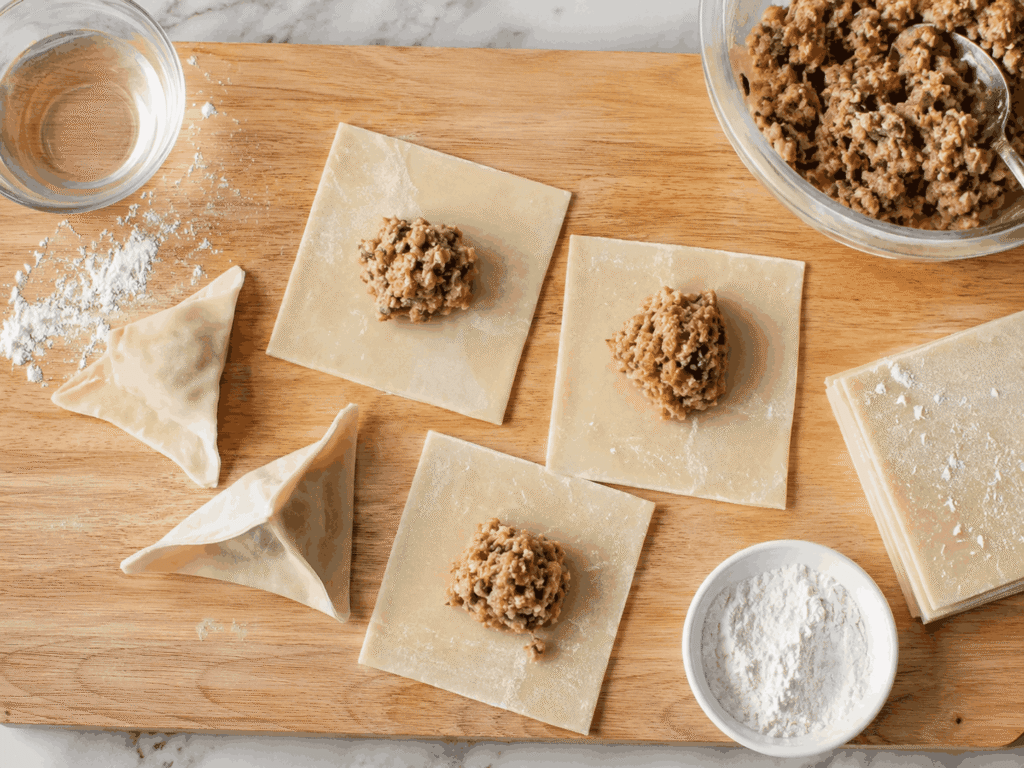
Store-bought wonton wrappers are convenient, but they're also thicker than they need to be, often edged with a dry rim that refuses to seal, and dusted with enough cornstarch to cloud your soup broth. Making them yourself takes four ingredients, about 20 minutes of active work, and produces sheets so thin you can read newsprint through them.
This guide walks through a tested wonton wrapper recipe, the exact dough hydration and thickness that gives you silky wontons instead of chewy ones, gluten-free alternatives that actually hold a pleat, and how to shop smart when you'd rather buy. You'll also get the folding techniques, storage rules, and the specific mistakes that ruin a batch.
What Are Wonton Wrappers?
Wonton wrappers are paper-thin sheets of unleavened wheat dough — flour, water, egg, and salt — cut into roughly 3-inch squares. They originate in Cantonese cooking, where wonton (雲吞) translates loosely as "swallowing clouds," a nod to how the pleated edges billow in hot broth.
The defining trait is thinness. A good wonton wrapper measures around 0.5–0.8 mm — thin enough that the filling shows through as a shadow. Egg is what makes that possible: the protein and fat in yolk tenderise the gluten network, so the dough rolls out further without tearing and cooks to a slippery, almost translucent finish.
Wonton Wrappers vs. Dumpling Wrappers vs. Egg Roll Wrappers
These get used interchangeably online, and they shouldn't be. The differences change how the dough behaves in the pan.
| Wrapper | Shape | Thickness | Egg? | Best for |
|---|---|---|---|---|
| Wonton | 3" square | 0.5–0.8 mm | Yes | Wonton soup, fried wontons, crab rangoon |
| Gyoza / dumpling | 3–3.5" round | 0.8–1.2 mm | No | Pan-fried gyoza, potstickers, steamed dumplings |
| Shumai | 2.5–3" square, very thin | 0.4–0.6 mm | Yes | Open-topped shumai |
| Egg roll / spring roll | 6–8" square | 1–1.5 mm | Yes (egg roll) | Deep-fried rolls |
In practice: you can cut a wonton wrapper into a circle and make passable gyoza, but the reverse fails. A gyoza wrapper in wonton soup turns gummy and doughy because the extra thickness never fully hydrates in the short boil.
Common Uses
- Wonton soup — boiled, served in clear chicken or pork broth
- Fried wontons — deep-fried until blistered, served with sweet chilli
- Crab rangoon — cream cheese and crab, folded into purses
- Wonton crisps — cut into strips, fried, and used like croutons on salads
- Baked wonton cups — pressed into a mini muffin tin for savoury or sweet fillings
- Quick ravioli — two wrappers sealed around ricotta, boiled 2 minutes
Ingredients and Why Each One Matters
| Ingredient | Amount | Purpose |
|---|---|---|
| All-purpose flour | 2 cups (250 g) | 10–11% protein gives enough gluten to roll thin without toughness |
| Large egg | 1 (about 50 g) | Tenderises, adds colour, improves elasticity |
| Cold water | 5–6 tbsp (75–90 ml) | Hydration; add gradually — flour absorbency varies |
| Fine salt | ½ tsp | Flavour and gluten structure |
| Cornstarch or tapioca starch | ¼ cup, for dusting | Keeps sheets separate; won't absorb into dough like flour does |
A few notes from working with this dough repeatedly:
Weigh the flour if you can. Two cups scooped straight from the bag can weigh anywhere from 240 g to 290 g, which is the difference between a rollable dough and a crumbly one. If you're measuring by volume, spoon flour into the cup and level it off.
Don't substitute bread flour unless you enjoy fighting your rolling pin. Higher protein means more gluten development and a dough that springs back faster than you can roll it.
Use cornstarch, not flour, for dusting. Flour hydrates into the dough surface and creates a gluey layer; starch stays inert and brushes off cleanly. The USDA's FoodData Central database is a useful reference if you want to compare protein content across flour types before you commit.
Total hydration lands around 48–50% — deliberately low. This is a stiff, firm dough, closer to fresh pasta than bread dough. If it feels soft and tacky, you've added too much water.
Easy Homemade Wonton Wrappers Recipe
Yield: 45–50 wrappers (3-inch squares) Active time: 25 minutes | Rest time: 30–60 minutes Difficulty: Beginner-friendly, no special equipment required
Step 1: Mix and Hydrate (5 minutes)
Whisk the flour and salt in a wide bowl. Beat the egg with 5 tablespoons of cold water, then pour it in while stirring with chopsticks or a fork.
You're aiming for shaggy, uneven crumbs — not a smooth ball. Squeeze a handful: if it holds together when pressed but crumbles when poked, hydration is right. If dry patches remain, add water one teaspoon at a time. A common mistake is dumping in the last tablespoon all at once and ending up with a sticky dough you then have to flour back into balance.
Step 2: Knead to a Smooth Ball (8–10 minutes)
Turn the crumbs onto an unfloured counter and knead. The first two minutes feel wrong — the dough will be stiff and reluctant. Keep going. Push with the heel of your hand, fold, rotate a quarter turn, repeat.
By minute eight the surface should be smooth and matte, like modelling clay. Press a thumb in: it should leave a clean dent that only slowly springs back. A stand mixer with a dough hook works on low speed for 6–8 minutes, but hand-kneading gives you better feedback on the texture.
Step 3: Rest — Don't Skip This (30–60 minutes)
Wrap tightly in plastic or seal in a zip bag and leave at room temperature for at least 30 minutes; 60 is better.
Resting lets the gluten strands relax and the water distribute evenly through the flour. Skip it and the dough fights back with every pass of the pin, snapping to half its rolled size the moment you lift the roller. Rest it properly and the same dough rolls out effortlessly. You can refrigerate the wrapped dough overnight — let it sit out 30 minutes before rolling.
Step 4: Roll Very Thin (10 minutes)
Cut the dough into four pieces. Keep three wrapped while you work on one.
By hand: Flour the surface lightly, flatten the piece, and roll from the centre outward, rotating 90° every few passes to keep it square. Aim for a sheet you can see your hand's shadow through — roughly 1 mm before it relaxes, settling near 0.7 mm.
With a pasta machine: This is the shortcut worth taking. Flatten the piece to fit the widest setting, pass it through, fold in thirds, and pass again twice more. Then step down through the settings to #6 or #7 on a standard Atlas-style machine. The sheets come out uniformly thin, which matters more than you'd think — uneven wrappers cook unevenly and burst at the thin spots.
Dust between every fold and stack with cornstarch. Be generous. Wrappers that fuse together are unsalvageable.
Step 5: Cut and Stack (5 minutes)
Trim the sheet to a rectangle, then cut 3-inch squares with a knife, pizza wheel, or bench scraper. A ruler and a light pencil-mark guide on your board makes the first few batches faster.
Dust each square, stack in piles of 10–12, and cover with a damp (not wet) tea towel. Wrappers dry out in under five minutes in a warm kitchen, and dry edges will not seal no matter how much water you brush on.
How to Fold Wontons: Four Reliable Shapes
The fold you choose depends on the cooking method. Boiled wontons need loose pleats that trap broth; fried ones need tight, flat seals that won't leak oil.
The Triangle (easiest)
Place 1 teaspoon of filling in the centre. Wet two adjoining edges with a fingertip of water, fold corner to corner into a triangle, and press out air as you seal from the filling outward. Trapped air expands in hot liquid and pops the seam.
The Nurse's Cap (classic soup wonton)
Fold the triangle first, then bring the two long points together underneath and pinch with a dab of water. This is the shape that floats and billows in broth.
The Purse (for crab rangoon)
Wet all four edges, gather the corners upward over the filling, and twist gently at the neck. Excellent for frying — the ruffled top blisters and crisps.
The Flat Rectangle (for pan-frying)
Fold once into a rectangle, seal three sides tightly, and press flat. Maximum surface contact with the pan means maximum crust.
Filling amount is where most people go wrong. One level teaspoon is right for a 3-inch wrapper. Overfilling is the single most common cause of blowouts — the seam simply cannot hold, and you'll lose the filling into the water. If you want bigger wontons, cut 3.5-inch squares rather than overstuffing 3-inch ones.
Gluten-Free Wonton Wrappers
Gluten-free wrappers are genuinely harder, because gluten is what lets wheat dough stretch thin without tearing. But a starch-based dough using boiling water works well — the heat gelatinises the starch and creates the stretch that gluten would otherwise provide.
Working Gluten-Free Formula
| Ingredient | Amount | Role |
|---|---|---|
| Tapioca starch | 1 cup (120 g) | Elasticity and chew |
| White rice flour | ½ cup (80 g) | Structure and body |
| Potato starch | ¼ cup (40 g) | Softness, tender bite |
| Xanthan gum | ¾ tsp | Binder; replaces gluten's cohesion |
| Salt | ½ tsp | Flavour |
| Boiling water | ¾ cup + 2 tbsp | Gelatinises the starch |
| Neutral oil | 1 tbsp | Pliability, prevents cracking |
Method: Whisk the dry ingredients. Pour in boiling water all at once and stir hard with a wooden spoon until it forms a sticky mass. Add the oil. Once cool enough to handle, knead 5 minutes until smooth and slightly glossy — it should feel like soft putty.
Roll between two sheets of parchment, not on a bare counter. This dough has no tolerance for a stuck spot. Cut into squares and keep tightly covered; gluten-free dough dries out roughly twice as fast as wheat dough.
Traditional vs. Gluten-Free: Honest Comparison
| Traditional (wheat) | Gluten-Free (starch) | |
|---|---|---|
| Texture cooked | Silky, slight chew | Softer, more slippery |
| Minimum thickness | 0.5 mm | ~1 mm before tearing |
| Tolerance for overfilling | Moderate | Low |
| Boiling | Excellent | Good — keep to a gentle simmer |
| Steaming | Good | Excellent (best method) |
| Deep frying | Excellent | Good; browns faster, watch closely |
| Freezes well | Yes, 3 months | Yes, but seal airtight |
| Make-ahead dough | Up to 2 days chilled | Same day only |
Practical verdict: steam or gently boil gluten-free wontons. A rolling boil tears them. If you're cooking for a mixed table, make the gluten-free batch as steamed shumai-style open dumplings — no seal to fail.
Where to Buy Wonton Wrappers
Making them is satisfying; buying them is faster on a Tuesday. Here's how to shop well.
Where to Look in the Store
Wonton wrappers are almost always refrigerated, not shelf-stable, which is why people miss them. Check in this order:
- Refrigerated produce section — often beside tofu, fresh noodles, and kimchi. This is the most common spot in US supermarkets.
- Asian foods aisle — sometimes there's a small chilled cabinet at the end of the aisle.
- Freezer case — frozen wrappers are common in larger chains and Asian markets.
- Deli or fresh pasta section — occasionally stocked here in smaller stores.
Walmart, Target, Kroger, Whole Foods, and most regional supermarkets carry them. Asian grocery stores — H Mart, 99 Ranch, Patel Brothers, or an independent local market — have the widest selection, including the paper-thin Hong Kong-style wrappers that supermarkets rarely stock.
What to Look For on the Package
- "Thin" or "Hong Kong style" on the label means a genuinely thin wrapper. Standard supermarket wrappers are noticeably thicker.
- Square = wonton, round = gyoza. Check the shape, not just the name.
- Check the date and squeeze the pack. Older wrappers stiffen and crack at the edges. If the stack feels rigid rather than pliable, put it back.
- Frozen is often better than old fresh. A well-frozen pack beats a fresh pack sitting three weeks past packing.
Thawing frozen wrappers: move the pack to the refrigerator overnight. Never microwave or run under water — the outer sheets go slimy and fuse while the centre stays frozen solid.
Cooking Methods and Timings
| Method | Setup | Time | Notes |
|---|---|---|---|
| Boiling | Large pot, gentle boil, plenty of water | 3–4 min from fresh, 5–6 from frozen | Done when they float and puff; add ½ cup cold water if the boil gets aggressive |
| Steaming | Lined bamboo or metal steamer, parchment or cabbage leaf | 8–10 min | Leave 1 inch between wontons; they expand |
| Pan-frying (potsticker method) | 1 tbsp oil, 2 min to brown, add ¼ cup water, cover | 8 min total | Crisp base, steamed top; lid off for the last minute |
| Deep-frying | Neutral oil at 350–360°F (175–182°C) | 2–3 min, turning once | Fry in small batches; crowding drops the oil temp and gives greasy results |
| Air-frying | Spray both sides with oil, 375°F (190°C) | 6–8 min, flip at 4 | Never as blistered as deep-fried, but far less mess |
The air fryer route is genuinely good for fried wontons and worth knowing if you already lean on quick countertop cooking for weeknight meals. Spray oil is not optional here — dry wrapper edges go papery and bitter.
Food safety note: wontons filled with raw pork, chicken, or shrimp need to reach a safe internal temperature. Pork and beef fillings should hit 160°F, poultry 165°F, per the FDA's food safety guidance. With a 1-teaspoon filling, the timings above achieve this comfortably — but if you make larger wontons, check one with an instant-read thermometer.
Filling Ideas That Work
The classic Cantonese filling is ground pork and shrimp with ginger, white pepper, Shaoxing wine, and sesame oil. Beyond that, almost anything finely chopped and well-seasoned works.
Savoury Fillings
- Pork and shrimp — 70/30 ratio, minced shrimp for texture
- Chicken and scallion — light and quick; the same seasoning approach used in poultry mince dinners translates directly to wonton filling
- Mushroom and cabbage — shiitake, napa cabbage, garlic chives; salt the cabbage and squeeze out water first
- Cheese and herb — ricotta or a drained soft cheese with lemon zest, essentially fresh ravioli
- Spiced lamb — cumin, coriander, and chilli, drawing on the flavour notes in North African home cooking
Sweet Fillings
- Apple cinnamon — diced apple with sugar and spice; a warm baking spice blend is exactly what you want dusted on top after frying
- Nutella and banana — fold flat, fry, dust with icing sugar
- Fig and mascarpone — a spoonful of slow-cooked fruit preserve with soft cheese, folded into purses and baked
One universal rule: fillings must be dry. Wet filling steams inside the wrapper, softens it from within, and blows the seam. Salt and drain watery vegetables, and chill meat fillings for 30 minutes before wrapping — cold filling is easier to portion and less likely to leak fat through the dough.
Storage and Make-Ahead Guide
| Item | Method | Duration |
|---|---|---|
| Fresh wrappers | Airtight container or zip bag, refrigerated, well dusted | 3 days |
| Fresh wrappers | Stacked between parchment, double-wrapped, frozen | 3 months |
| Uncooked dough ball | Tightly wrapped, refrigerated | 2 days |
| Filled uncooked wontons | Flash-frozen then bagged | 2 months |
| Cooked wontons | Refrigerated in broth-free container | 2 days |
How to Freeze Filled Wontons Properly
This is the technique that makes wontons a weeknight food:
- Line a sheet pan with parchment and dust it with cornstarch.
- Arrange filled wontons in a single layer, not touching.
- Freeze uncovered for 60–90 minutes until solid.
- Transfer to a zip bag, press out the air, and label with the date.
Cook straight from frozen — never thaw. Add 2 minutes to the boiling time. Thawed filled wontons turn into a soggy, torn mess because the wrapper absorbs meltwater.
Working tip: keep a damp tea towel over your wrapper stack and a second one over your finished wontons. In a dry kitchen, exposed wrappers become unusable within five minutes.
Common Mistakes to Avoid
Rolling too thick. The most common problem by a wide margin. If your wontons taste doughy or the wrapper is still pale and pasty after boiling, it's thickness. Roll until it feels almost too fragile.
Skipping the rest. Unrested dough contracts the instant you stop rolling. You'll blame the recipe when the issue is 30 minutes of patience.
Dusting with flour instead of starch. Flour absorbs moisture from the dough surface and turns gluey, then clouds your broth. Cornstarch or tapioca starch stays dry and brushes away.
Overfilling. One teaspoon. A heaped teaspoon in a 3-inch wrapper will split.
Trapping air in the seal. Press from the filling outward and squeeze air out before closing the final edge. Air expands in hot water and bursts the seam.
Wet filling. Undrained cabbage, watery sauce, or a filling with too much soy sauce will soak through the wrapper on the tray before it ever reaches the pot.
Boiling too hard. A violent rolling boil batters the wrappers apart. Keep it at a lively simmer; splash in cold water if it climbs.
Sealing dry wrappers. Water won't rescue a wrapper whose edges have already crisped. Keep them covered from the moment they're cut.
Cost and Time: Is Homemade Worth It?
Honest accounting:
- Cost: four ingredients from the pantry make 45–50 wrappers. A store pack of 50 typically costs a few dollars. Homemade is cheaper, but not dramatically so.
- Time: 25 minutes of active work plus a 30-minute rest, versus a two-minute grab in the store.
- Quality: this is where homemade wins clearly. You control thickness, there's no chalky cornstarch coating, no dried-out edges, and no preservatives. Genuinely thin wrappers are hard to buy outside a well-stocked Asian market.
When to make them: for wonton soup, where wrapper texture defines the dish; when you want a specific thinness; when you're gluten-free; when you want a hands-on cooking project.
When to buy: weeknight fried wontons, crab rangoon, and wonton cups — the filling and the frying dominate, and the wrapper difference largely disappears.
Serving Suggestions
Wontons rarely stand alone. A few combinations that work:
- Wonton soup — clear pork or chicken broth, blanched bok choy, sliced scallion, white pepper
- Chilli oil wontons — boiled, drained, tossed in black vinegar, soy, garlic, and chilli oil
- Fried wontons as an appetiser — alongside crisp seasoned vegetables for a lighter plate
- Wonton crisps on soup or salad — fry cut strips for 45 seconds, salt immediately
- Dessert wontons — fried and dusted with sugar, served with the same warm-spice appeal as a morning sweet roll
- Dipping sauces — soy plus rice vinegar plus sesame oil; sweet chilli; or ginger-scallion oil. A cup of freshly brewed tea alongside cuts the richness of anything fried
Ready to try this? Make one batch of wrappers this weekend, fill half for dinner and flash-freeze the rest — you'll have restaurant-quality wontons ready in four minutes on your next busy night. For more weeknight-friendly ideas to build the rest of the meal around, our full collection of tested dishes is the place to start.
Frequently Asked Questions
Can I make wonton wrappers without egg?
Yes. Use 2 cups flour, ½ teaspoon salt, and ¾ cup water. Eggless wrappers are slightly less elastic and won't roll quite as thin, so aim for around 1 mm and expect a marginally chewier bite. They hold up well to boiling and steaming.
Why do my wrappers keep tearing when I roll them?
Usually one of three things: the dough hasn't rested long enough, hydration is too low (dry dough cracks rather than stretches), or you're rolling too aggressively in one direction. Rest another 20 minutes, rotate the sheet 90° between passes, and if the dough feels stiff and crumbly, work in a teaspoon of water.
Are wonton wrappers the same as dumpling wrappers?
No. Wonton wrappers are square, thinner (0.5–0.8 mm), and typically contain egg. Dumpling and gyoza wrappers are round, thicker, and usually eggless so they can withstand pan-frying and steaming. You can cut wonton wrappers into circles in a pinch, but gyoza wrappers make disappointing soup wontons.
Can I use a pasta machine?
Yes — it's the single biggest upgrade to this recipe. Laminate the dough through the widest setting a few times, then step down to setting #6 or #7. Uniform sheets cook evenly and don't burst at thin spots. Dust with cornstarch between passes.
How thin should wonton wrappers be?
Around 0.5–0.8 mm for soup wontons — thin enough to see a shadow through. For frying you can go slightly thicker (up to 1 mm) since the wrapper needs enough body to hold structure in hot oil. Gluten-free dough tears below about 1 mm.
Can I freeze homemade wonton wrappers?
Yes, for up to 3 months. Stack them with parchment between every 5–10 wrappers, dust generously with cornstarch, then double-wrap in plastic and a freezer bag. Thaw overnight in the refrigerator, never at room temperature or in the microwave.
Why do my wontons burst when boiling?
Almost always overfilling, trapped air, or too hard a boil. Use one level teaspoon of filling, press air out as you seal, and keep the water at a lively simmer rather than a rolling boil.
Can I make the dough ahead?
Yes. Wrapped tightly, the dough keeps 2 days in the refrigerator — the extra rest actually improves how it rolls. Let it come to room temperature for 30 minutes first. Gluten-free starch dough is best used the day it's made.
What can I use instead of wonton wrappers?
Gyoza wrappers (cut square if you like), spring roll pastry cut down for frying, or fresh pasta sheets cut into 3-inch squares. Rice paper works for fresh rolls but not for boiling. In a pinch, thin fresh lasagne sheets make surprisingly good boiled wontons.
Do I need a special cutter?
No. A sharp knife, a pizza wheel, or a bench scraper against a ruler all work fine. Consistency matters more than perfect edges — evenly sized wrappers cook at the same rate.
Final Thoughts
Homemade wonton wrappers come down to three things: a stiff dough at roughly 48–50% hydration, a genuine 30-minute rest, and rolling thinner than feels comfortable. Get those right and the rest is repetition — by your second batch you'll be rolling and cutting in under 20 minutes.
The payoff is real. Silky, translucent wrappers that seal cleanly, hold their shape in broth, and blister properly in oil are hard to buy and easy to make. Start with the classic pork-and-shrimp filling, freeze half the batch flat on a tray, and you'll have better-than-takeout wontons on standby.
Cook a batch this week, note what you'd change about thickness, and adjust next time. That single loop of practice is what separates good wontons from great ones.


3 thoughts on “Wonton Wrappers Recipe: Easy Homemade Guide for Perfect Dumplings”