
One pot pasta works because the starch that normally goes down the drain stays in the pan and becomes your sauce. That single change is what turns a 25-minute weeknight dinner into something that tastes like it simmered for an hour, and it's why these recipes hold up long after the novelty of "fewer dishes" wears off.
This guide covers five tested recipes, the liquid ratios that actually work, which pasta shapes survive the method and which turn to mush, how to add cheese without it going grainy, and how to store and reheat leftovers so they don't seize into a solid block. Everything here is written for a standard home stove and a pot you already own. You can also read our guide on easy vegetarian dinner recipes.
Why One Pot Pasta Works: The Starch Explanation
When you boil pasta conventionally, roughly 5 to 10 percent of its weight leaches out as starch and dissolved protein into the water. You pour most of that down the sink, then rebuild body in the sauce with butter, cream, cheese, or a splash of reserved pasta water.
Cook the pasta in the sauce instead and none of it escapes. Amylose and amylopectin — the two starch molecules in wheat — swell, burst, and disperse into the surrounding liquid, thickening it the way a cornstarch slurry would, but with flavor attached. Dry pasta absorbs roughly its own weight in liquid as it hydrates, so a pot that starts as thin broth finishes as a glossy sauce that clings.
Two practical consequences follow from this, and they explain nearly every one pot pasta failure:
- Your liquid is your seasoning. Whatever you cook the pasta in ends up inside the pasta. Water gives you bland pasta in a starchy puddle. Seasoned broth gives you pasta seasoned all the way through.
- The sauce thickens continuously and irreversibly. There is no draining step to stop the process. A pot that looks perfect on the stove will be noticeably tighter three minutes later on the plate.
What You Gain and What You Give Up
Honest trade-offs, because most articles skip this part:
| Gain | Give up |
|---|---|
| Deeply seasoned pasta, no bland interior | Precise doneness control — you can't taste-and-drain |
| Sauce thickens itself, no roux or slurry | Some shapes (delicate fresh pasta, angel hair) don't survive |
| One pot to wash | Needs near-constant attention for the first 5 minutes |
| Vegetables and protein cook in the same liquid | Harder to scale past 4–6 servings without a very wide pot |
| Fewer ingredients needed for body | Leftovers keep absorbing liquid overnight |
In practice, the doneness issue is the one that trips people up. You cannot fish out a strand, bite it, and dump the rest into a colander. You have to learn to read the pot — the liquid should be reduced to a loose, glossy coating when the pasta is just shy of al dente, not a swimming pool and not a dry pan.
The Right Pot Matters More Than the Recipe
Use a wide, heavy-bottomed pot or a deep sauté pan — something with 10 to 12 inches of surface area and thick walls. A tall narrow stockpot is the wrong tool: the pasta piles up, the bottom layer scorches, and the top layer never hydrates evenly.
Heavy bottoms matter because you're simmering a starchy liquid directly on metal. Thin aluminum develops hot spots and the starch catches there within seconds. Enameled cast iron, a tri-ply stainless skillet, or a Dutch oven all work well. If your only option is a thin pot, drop the heat one notch and stir more often.
The Liquid Ratio: Get This Right and Everything Else Follows
Start with 2 cups of liquid per 100 g (about 3.5 oz) of dry pasta. That is the baseline for a covered pot at a steady simmer, and it lands close to correct for most long and short shapes.
Then adjust:
| Situation | Adjustment | Reason |
|---|---|---|
| Uncovered pot | Add ¼–½ cup extra | Evaporation runs faster |
| Whole wheat or chickpea pasta | Add ¼ cup extra, cook 2–3 min longer | Denser, absorbs more slowly |
| Cream or milk in the liquid | Reduce total slightly | Dairy reduces to a thicker body |
| Watery vegetables (zucchini, tomatoes, spinach) | Reduce by ¼ cup | They release liquid as they break down |
| Gas stove on high | Watch closely, top up as needed | Aggressive boil evaporates fast |
| Doubling the recipe | Do not double blindly | Wider pan surface changes evaporation; add liquid in stages |
Keep a mug of hot broth or water beside the stove. Topping up mid-cook is completely normal and far easier to fix than a soupy pot you have to boil down while the pasta overcooks. A common mistake is treating the ratio as a rigid formula rather than a starting point — the pot tells you what it needs if you look at it.
The 5 Best One Pot Pasta Recipes
1. One Pot Creamy Garlic Parmesan Pasta
The gateway recipe. Rich, sharp, garlicky, and done in about 25 minutes with five real ingredients.
Serves 3–4 | Active time: 25 minutes
Ingredients:
- 300 g (10.5 oz) spaghetti or linguine, snapped in half if your pot is narrow
- 4 cloves garlic, thinly sliced (not crushed — slices won't scorch as fast)
- 2½ cups low-sodium chicken or vegetable broth
- 1 cup heavy cream
- 1 cup Parmigiano-Reggiano, grated from a block
- Salt, coarse black pepper, chopped flat-leaf parsley
Method:
- Combine pasta, garlic, broth, and cream in a wide pot over medium-high heat. Cold start, everything at once.
- Bring to a rolling boil, stirring constantly for the first 2 minutes so the strands separate rather than fusing into a raft.
- Drop to a steady simmer. Cook 10–12 minutes, stirring every minute or so, until the pasta is just under al dente and the liquid has reduced to a loose sauce.
- Kill the heat entirely. Let it sit 30 seconds, then add the Parmesan in three additions, stirring each one until it disappears before adding the next.
- Season, finish with parsley, serve straight away.
Why the Parmesan matters: pre-shredded cheese is coated in cellulose or potato starch to stop it caking in the bag. Those coatings don't dissolve into a sauce — they leave a faint chalkiness and resist melting smoothly. Grate from a wedge and the difference is immediately obvious.
Fix it if: the sauce is too thick, stir in a splash of hot broth off the heat. Too thin, return to low heat for 60 seconds before the cheese goes in, never after.
2. One Pot Tomato Basil Pasta
The recipe that made the whole method famous, and it still earns its reputation. Cherry tomatoes collapse into a jammy, glossy sauce with nothing but heat and time.
Serves 4 | Active time: 20 minutes
Ingredients:
- 350 g (12 oz) linguine or spaghetti
- 500 g (about 1 lb) cherry or grape tomatoes, halved
- 4 cloves garlic, sliced
- 1 small onion, thinly sliced
- 3 tbsp extra-virgin olive oil, plus more to finish
- 2½–3 cups vegetable broth
- Large handful fresh basil, plus more to serve
- ½ tsp chili flakes (optional)
Method:
- Add everything except the finishing oil and basil to the pot. No pre-cooking, no browning.
- Bring to a boil over high heat, stirring frequently.
- Cook 9–11 minutes at a strong simmer. The tomatoes will burst on their own; press a few against the side of the pot with your spoon to speed it along.
- When the liquid has reduced to a glossy sauce and the pasta is just tender, pull it off the heat.
- Tear in the basil, add a real glug of good olive oil, and toss hard for 20 seconds. That final oil emulsifies with the starch and is what makes the sauce shine.
Halving the tomatoes is worth the two minutes. Whole ones burst unpredictably and some stay intact; halved ones release juice from the start and build sauce more evenly. If you have a surplus of them and want more ways to use them up, our small tomato ideas cover plenty of ground beyond pasta.
3. One Pot Cheesy Chicken and Bacon Pasta
Comfort food at full volume. This one breaks the cold-start rule for good reason — bacon and chicken need a hot dry pan first.
Serves 4 | Active time: 35 minutes
Method outline:
- Render 150 g (5 oz) diced bacon in the dry pot over medium heat until crisp, 6–8 minutes. Remove the bacon, leave the fat.
- Brown 500 g (1 lb) diced chicken thighs in that fat, in a single layer, without moving them for the first 3 minutes. You want colour, not steam.
- Add sliced onion and garlic, then deglaze with a splash of broth, scraping every browned bit off the bottom.
- Add 350 g short pasta and 3 cups broth. Simmer 11–13 minutes, stirring regularly.
- Off the heat, stir in 1 cup sharp cheddar and ½ cup low-moisture mozzarella in stages, then the reserved bacon.
Why it tastes deeper than it should: browning the chicken and bacon creates Maillard compounds that dissolve into the broth, and the pasta then absorbs that broth. Every strand carries the fond. Pre-cooked rotisserie chicken stirred in at the end simply cannot do this, which is the single biggest reason shortcut versions taste flat.
Thighs beat breast here — more fat, more forgiving, and they stay tender through a 12-minute simmer. If you'd rather work with breast meat, the techniques in our guide to cooking leaner cuts well apply directly.
Shapes that work: penne, rigatoni, fusilli, cavatappi. Ridges and tubes trap cheese sauce inside and out.
Finish it: a handful of frozen peas and a squeeze of lemon in the last 30 seconds. The acid cuts the fat and stops the dish tasting heavy by the third forkful.

Cheese added off the heat melts into a glossy coating instead of separating into oily strings.
4. One Pot Mac and Cheese
Twenty minutes, one pot, and a sauce that stays smooth rather than splitting into grease and grain.
Serves 4 | Active time: 20 minutes
The cheese combination does the heavy lifting:
| Cheese | Amount | Job |
|---|---|---|
| Sharp cheddar | 1 cup | Flavour. Aged cheddar brings the tang, but alone it can turn oily |
| Gruyère | ½ cup | Meltability and nutty depth; smooths out the cheddar |
| Cream cheese | 2 tbsp | Emulsifier — its stabilisers keep fat and water bound together |
Method:
- Cook 300 g elbow macaroni in 1½ cups whole milk plus 1½ cups low-sodium broth over medium heat. Milk scorches faster than water, so stir often and keep the heat moderate.
- When the pasta is just tender and the liquid is thick and mostly absorbed, remove from the heat.
- Cream cheese first, stirred until fully dissolved. This builds the emulsion the other cheeses will join.
- Cheddar and Gruyère in two additions, stirring until smooth between each.
- Season with ½ tsp mustard powder, ¼ tsp smoked paprika, plenty of black pepper, and salt to taste. Mustard powder is not optional — it sharpens dairy flavour and helps the emulsion hold.
- Serve immediately. It sets up fast as it cools.
The graininess problem, explained: cheese is fat and water held in a protein mesh. Above roughly 82°C (180°F), casein proteins tighten and squeeze out the fat, and you get grease on top with grit underneath. Off the heat, in stages, is the whole trick. If it does break, a teaspoon of cornstarch slurried in a little cold milk and stirred through over gentle heat will usually pull it back.
If melty, family-sized dinners are your thing, there's plenty more in the same vein across our full recipe archive.
5. One Pot Spinach and Ricotta Pasta
Vegetarian, elegant, and the fastest of the five. Ricotta melts into the starchy liquid to form a white sauce with no roux and no cream.
Serves 3–4 | Active time: 20 minutes
Method outline:
- Soften 1 sliced leek or onion in 2 tbsp olive oil, 4 minutes.
- Add 300 g short pasta, 2½ cups vegetable broth, a grating of nutmeg. Simmer 10–12 minutes.
- Off the heat, stir in 250 g whole-milk ricotta plus ½ cup grated Parmesan until glossy.
- Fold in 150 g baby spinach. Residual heat wilts it in under a minute — any longer and you lose both colour and texture.
- Finish with lemon zest, toasted pine nuts, black pepper, and good olive oil.
Use whole-milk ricotta. Part-skim has a higher water content and a firmer curd, so it tends to stay slightly granular rather than dissolving into the sauce. Drain it briefly if it looks watery in the tub.
For more meat-free mains built on the same cook-once principle, browse the meatless dinner ideas in our cottage cheese collection, where soft fresh cheeses do similar work.
Best Pasta Shapes for One Pot Cooking
Shape choice affects whether your dish comes out glossy or gluey. Dried semolina pasta is what you want here — bronze-cut if you can find it, because the rougher surface releases starch more readily and grips sauce better.
| Shape | Best sauce match | Why it works | Approx. simmer time |
|---|---|---|---|
| Linguine / spaghetti | Light broth or cream | Long strands hydrate evenly; snap in half for narrow pots | 10–12 min |
| Penne / rigatoni | Chunky tomato, meat, cheese | Tubes fill from the inside; sturdy walls resist mush | 11–13 min |
| Fusilli / rotini | Cheesy and creamy | Spiral grooves hold thick sauce in every turn | 11–13 min |
| Orecchiette | Greens, sausage, broccoli | Cup shape scoops up small chunky ingredients | 12–14 min |
| Orzo | Soup-style, risotto-style | Cooks fast, behaves like rice, releases lots of starch | 8–10 min |
| Cavatappi | Mac and cheese variants | Corkscrew tubes trap sauce twice over | 10–12 min |
Avoid angel hair and capellini (they overcook in the time it takes the sauce to reduce), fresh egg pasta (cooks in 2–3 minutes, far too fast for the liquid to reduce), and no-boil lasagne sheets (they tear and clump). Gluten-free corn and rice pasta can work but releases a lot more loose starch — use ¼ cup less liquid and stir gently, since GF shapes break apart when agitated hard.
If you like knowing why a dough behaves the way it does, the same logic shows up in our thin dough wrappers recipe, where hydration and starch control everything.
Five Rules for Perfect One Pot Pasta Every Time
1. Stir hard for the first five minutes. Sticking and clumping happen almost entirely in the early window, before the surface starch has dispersed and while strands are still soft and tacky. Once the pasta has loosened and the liquid has visibly thickened, an occasional stir is enough. Scrape the bottom corners of the pot, not just the middle.
2. Pull it off the heat 1–2 minutes early. Residual heat plus a thick, hot sauce keeps cooking the pasta after the burner is off. Target just-firm-under-the-tooth on the stove and it will be perfect al dente on the plate. Testing at the exact minute the recipe says is how you end up with soft pasta.
3. Reserve a ladle of cooking liquid before you add anything dairy. This starchy liquid is the only thing that loosens a tight sauce without diluting flavour. Plain water thins the seasoning; cream flattens the acidity. Set aside half a cup and you have an insurance policy.
4. All cheese goes in off the heat, in stages. Covered above, but it bears repeating because it's the most common failure. Heat off, brief pause, then thirds.
5. Salt in layers, taste at the end. Broth, cheese, bacon, and Parmesan all carry salt, and the liquid reduces by more than half, concentrating everything. Start with low-sodium broth and season at the finish. The USDA's dietary guidance puts most adults well above recommended sodium intake, and a dish built on broth plus cured meat plus hard cheese is exactly where that creeps up unnoticed. Controlling it is easy if you build from an unsalted base.
Food Safety: The Part Most Recipes Skip
One pot pasta often includes raw chicken, and the pot never gets drained, so anything that started in there stays in there.
- Cook poultry to 74°C (165°F) internal. Diced thighs simmering in liquid for 12 minutes will comfortably exceed this, but check the largest piece with an instant-read thermometer if you're unsure. The USDA's food safety guidance is the reference point for safe internal temperatures.
- Don't crowd raw protein into a lukewarm pot. Brown it first, in fat, over real heat.
- Cool leftovers fast. Get cooked pasta into shallow containers and into the fridge within two hours. A deep pot of hot starchy pasta left on the stovetop sits in the temperature danger zone for hours.
- Reheat to steaming hot throughout, not just warm at the edges. Stir halfway through microwaving.
Making One Pot Pasta Healthier Without Losing Flavour
The method is naturally cooperative here, because vegetables and lean protein go into the same liquid and pick up the same seasoning.
Swaps That Genuinely Work
- Whole wheat or legume pasta — chickpea and red lentil shapes bring meaningful fibre and protein and hold up in creamy and tomato sauces. They need slightly more liquid and a couple of extra minutes. Expect a firmer bite and a nuttier flavour rather than a like-for-like match.
- Whole milk or half-and-half instead of heavy cream — you lose some richness but keep the body, especially if you lean on the pasta starch. Add a little extra Parmesan to compensate.
- Nutritional yeast alongside (not instead of) Parmesan — savoury depth with less sodium. A full swap tastes noticeably different; a half swap is barely detectable.
- Low-sodium broth as the base — the single highest-impact change, because it hands salt control back to you.
- Pack in vegetables — the pot is right there and they season themselves in the broth.
Vegetable Timing Chart
| Vegetable | When to add | Notes |
|---|---|---|
| Sliced mushrooms | Before the pasta, sautéed | Brown them for flavour; they release water |
| Onion, leek, fennel | Before the pasta, softened | Builds the aromatic base |
| Bell peppers | With the pasta | Finish tender-crisp |
| Broccoli florets | 5 minutes before the end | Small florets only, or they stay raw inside |
| Courgette / zucchini | 4 minutes before the end | Releases water — cut liquid slightly |
| Frozen peas or corn | Last 60 seconds | No pre-cooking needed |
| Baby spinach, chard leaves | Off the heat | Wilts in residual steam; keeps colour |
| Cherry tomatoes | With the pasta | Burst into the sauce |
Sturdy greens are especially good value here — the stems can go in early with the aromatics and the leaves at the very end, as in our rainbow-stemmed greens recipes.
Meal Prep, Storage and Reheating
One pot pasta reheats better than most people expect, but it needs two adjustments made before you ever put it in a container.
Undercook the first batch deliberately. Pull it a full 2 minutes early. The pasta keeps absorbing sauce overnight in the fridge and softens again on reheating. Perfectly al dente today is soft tomorrow.
Leave the sauce slightly loose. Cold pasta looks dry and set no matter what you do, but a sauce that was thin on day one comes back to life; one that was already thick turns to paste.
Storage Guide
| Method | Duration | Notes |
|---|---|---|
| Refrigerator | 3–4 days | Airtight container, shallow, cooled within 2 hours |
| Freezer, tomato-based | Up to 3 months | Freezes cleanly; thaw overnight in the fridge |
| Freezer, cream or cheese-based | Not recommended | Emulsions split on thawing and rarely recover fully |
| Freezer, baked pasta | Up to 2 months | Holds better than a loose sauce; reheat covered in the oven |
Reheating: add a splash of broth, milk, or water before you apply any heat — 1 to 2 tablespoons per portion. On the stovetop, use low heat and stir gently. In the microwave, cover loosely and go in 60-second bursts, stirring between each. Reheating dry on high heat is what produces the rubbery, separated texture people blame on the recipe.
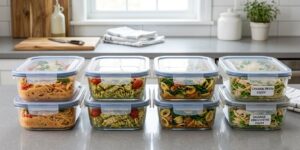
Shallow glass containers cool faster and reheat more evenly than one deep tub.
For a rounded make-ahead week, pair a tomato-based pot with something from a different cooking method — batch-cooked poultry or a tray of quick-roasted vegetables both hold their texture better than pasta does across four days.
Troubleshooting: Diagnose It in Ten Seconds
| Problem | Cause | Fix now | Prevent next time |
|---|---|---|---|
| Soupy and thin | Too much liquid, or lid left on | Simmer uncovered 2–3 min; add Parmesan to tighten | Measure liquid; start with 2 cups per 100 g |
| Gluey and pasty | Too little liquid, overcooked | Loosen with hot broth off the heat | Pull 2 min early; top up mid-cook |
| Scorched bottom | Thin pot, heat too high, not stirred | Don't scrape — decant the good pasta into a clean bowl | Heavy pot, medium heat, scrape corners often |
| Grainy cheese sauce | Cheese added over heat | Cornstarch slurry in cold milk, stir over low heat | Heat fully off, cheese in thirds |
| Bland despite salt | Cooked in water, not broth | Finish with Parmesan, lemon, acid | Use seasoned broth from the start |
| Pasta clumped into a raft | No stirring in the first 2 min | Break apart with tongs, add splash of liquid | Stir constantly until the boil is established |
| Unevenly cooked strands | Pot too narrow, pasta not submerged | Push down, add liquid, stir from the bottom | Wide pan; snap long pasta in half |
| Sauce split and oily | Boiled after dairy went in | Off heat, stir in a splash of cold milk or a knob of butter | No boiling once cream or cheese is in |
What to Serve Alongside
One pot pasta is a complete meal, but a second element turns it into dinner rather than a bowl.
- Something acidic and raw. A sharp green salad or quick-pickled onions resets the palate between rich bites. This matters most with the cheese-heavy versions.
- Bread that can push sauce around. Garlic bread, focaccia, or a wedge of skillet cornbread for the tomato-based pots.
- A separately cooked protein if you want to keep the pasta simple — crisp-skinned salmon next to the spinach and ricotta version is a genuinely good plate, and herby beef spheres suit the tomato basil pot.
- Something warm to drink afterwards. A properly steeped brew does more for a heavy dinner than another glass of anything cold.
Save one of these five recipes to your phone now and cook it this week — you'll learn more from one attempt at reading the pot than from reading another ten guides.
Frequently Asked Questions
Can you cook raw pasta directly in sauce?
Yes, and it's the whole point of the method. The pasta absorbs the liquid as it hydrates and releases starch that thickens what's left. Use roughly 2 cups of liquid per 100 g of dry pasta as a starting point, stir frequently in the early minutes, and top up with hot broth if the pot dries out before the pasta is tender.
Why does my one pot pasta come out gummy?
Almost always too little liquid, too little stirring, or both. Insufficient liquid means concentrated starch coats the pasta rather than dispersing into a sauce. Delicate shapes make it worse. Use a wide heavy pot, keep the heat at a steady simmer rather than a hard boil, and choose sturdy shapes like penne or fusilli.
What is the best liquid to use?
Low-sodium chicken or vegetable broth. It seasons the pasta from the inside as it cooks, which water cannot do. Broth plus cream gives a richer sauce; broth plus tinned or fresh tomatoes gives an Italian-style one. Milk works for mac and cheese but scorches more easily, so keep the heat moderate and stir often.
Can I make one pot pasta without cream?
Easily. Broth as the base plus a generous amount of freshly grated Parmesan off the heat produces a genuinely creamy sauce from starch and cheese alone. Dairy-free routes include cashew cream, full-fat coconut milk (best with curry or chili flavours), or a few tablespoons of blended white beans, which thicken without adding much flavour.
How do I stop it sticking to the bottom?
Stir and scrape the bottom during the first five minutes, use a wide heavy-bottomed pot, keep the heat at medium to medium-high rather than full blast, and never let the liquid drop below a thin layer across the base. If you smell anything toasting, take it off the heat immediately and don't scrape the burnt layer up into the sauce.
Can I double the recipe?
Up to a point. Doubling in the same pot doesn't work — you need proportionally more surface area or the pasta piles up and cooks unevenly. Use the widest pot you own, add liquid in stages rather than doubling it upfront, and expect a slightly longer cook. Beyond about 8 servings, two pots is the more reliable answer.
Is one pot pasta healthier than the traditional method?
Nutritionally the pasta itself is the same. What changes is control: you choose the sodium level in the broth, you're not adding butter or cream to build a sauce that starch already provides, and vegetables and lean protein go in without extra effort or extra pans. Whole grain or legume pasta plus low-sodium broth is where the real improvement comes from.
Which cheeses work best?
Parmigiano-Reggiano for sharpness and clean melting, Gruyère for depth and meltability, sharp cheddar for classic mac and cheese flavour, cream cheese as a small-quantity emulsifier that keeps the sauce stable, and whole-milk ricotta for light vegetarian versions. Grate from a block, add off the heat, and add in stages every time.
Can I use gluten-free pasta?
Yes, with adjustments. Corn and rice blends release more loose starch, so reduce liquid by about ¼ cup and stir gently — vigorous stirring breaks the shapes. Check for doneness 2 minutes before the package time, because GF pasta goes from firm to disintegrating quickly. Legume-based shapes hold together better than rice-based ones.
Conclusion
The single idea worth taking away: in one pot pasta, the cooking liquid becomes the sauce, so season it properly, measure it roughly at 2 cups per 100 g of dry pasta, and stop cooking a minute or two before you think you should. Get those three things right and the recipes almost cook themselves — cheese off the heat, a wide heavy pot, and a ladle of reserved liquid handle everything else.
Start with the creamy garlic Parmesan version tonight. It's the most forgiving of the five, it needs nothing you don't already have, and once you've felt the moment the liquid turns glossy and starts clinging to the pasta, you'll recognise it in every one pot recipe you cook afterwards. From there, our tested recipe library has plenty of one-vessel dinners to keep the washing-up honest.



1 thought on “One Pot Pasta Recipes That Are Easy, Cheesy and Absolutely Delicious”